
Are your wooden interior doors ready for the new formaldehyde regulation?
From 6 August 2026, European rules on formaldehyde emissions will become significantly stricter. In Belgium as well, this legislation will have a direct impact on wooden interior doors and other wood-based products placed on the market.
For manufacturers, importers, distributors, and specifiers, this is not a minor regulatory update but an essential compliance obligation. In this blog, we explain what Regulation (EU) 2023/1464 specifically means for the Belgian interior door market.
What is formaldehyde and why is it regulated?
Formaldehyde is a volatile organic compound (VOC) commonly found in wood-based materials such as particleboard, MDF, and plywood. It can be released from the adhesives, resins, and coatings used in the production of interior doors and other interior applications.
Because prolonged exposure to formaldehyde can be harmful to human health, the European Union has decided to further lower emission limits for indoor air. This measure is part of a broader European policy focused on healthy indoor air quality and consumer protection.
The formaldehyde regulation (EU) 2023/1464 in a nutshell
Regulation (EU) 2023/1464 amends Annex XVII of the REACH Regulation by adding entry 77 (formaldehyde).
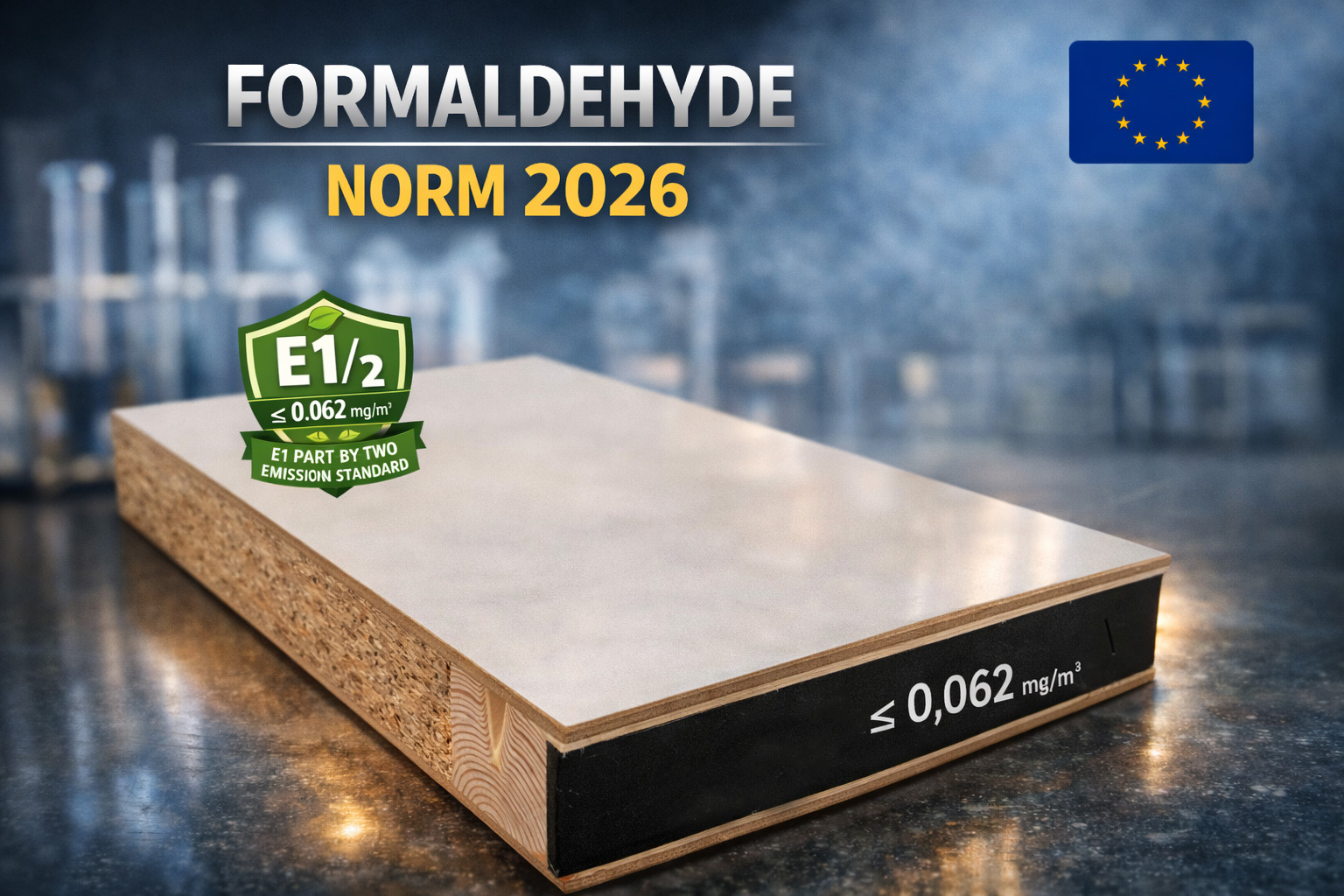
In practical terms, this means that from 6 August 2026, furniture and wood-based articles—such as wooden interior doors—must comply with a maximum formaldehyde emission of ≤ 0.062 mg/m³.
This value is measured in a standardized test chamber under the test conditions described in Appendix 14 of Annex XVII (REACH).
When does the formaldehyde standard enter into force?
Article 3(12) of REACH is clear: any non-compliant stock may no longer be sold after 6 August 2026.
A crucial aspect of this regulation is the definition of “placing on the market.” According to this article, it refers to supplying or making available—whether for payment or free of charge—to a third party. Import is considered placing on the market.
For the Belgian market, the official clarification from DG ENVI and DG GROW of the European Commission is particularly important:
the rule is not limited to the first sale;
any supply or availability after 6 August 2026 is considered a new placing on the market;
this also applies to products manufactured or imported before that date.
Which interior doors fall under the formaldehyde standard?
In Belgium, the following products are subject to the strictest limit of 0.062 mg/m³:
wooden interior doors;
wood-based door leaves;
composite door sets.
In short, wooden interior doors are considered “wood-based articles” under the REACH definition.
Which doors are exempt and do not fall under this standard?
The regulation provides several exemptions to the formaldehyde limit:
second-hand doors;
doors intended exclusively for outdoor use;
products in which formaldehyde occurs only naturally (for example, solid wood without added resins);
products applied exclusively outside the building envelope and vapour barrier.
For standard interior doors in residential and commercial buildings in Belgium, these exemptions generally do not apply.
How do you demonstrate compliance of your interior doors in practice?
1. Chamber test
The reference method is the chamber test as described in Appendix 14 of Annex XVII of REACH:
emission value ≤ 0.062 mg/m³;
test performed by an ISO 17025 accredited laboratory.
2. Documentation and traceability
Compliance must be demonstrable through:
test reports;
product and batch information;
material data (adhesives, resins, coatings);
a Declaration of Conformity with explicit reference to Regulation (EU) 2023/1464.
3. Specific situation for wooden interior doors
For interior doors, a full chamber test of the finished product is not mandatory, provided you can demonstrate that all individual door components (door leaf, core, finish, frame) are individually compliant.
This can be demonstrated through certificates and DOPs of the materials used. Transparency and consistency in documentation are, of course, crucial.
What does the formaldehyde legislation mean for the Belgian door sector?
What can Belgian manufacturers, importers, and distributors expect from the new formaldehyde standard?
timely evaluation of existing products;
verification of suppliers and materials used;
updating of technical files;
clear communication to customers and partners.
Those who only address this in 2026 run a real risk of ending up with unsellable stock.
At Solid Binnendeuren, we take a proactive approach!
This ensures that our customers and partners remain fully compliant even beyond 2026. Would you like to discuss the impact of the formaldehyde legislation on your products or projects?